180. El Ciprés Candelabro
I’ve been travelling, so this week’s tree is neither British nor Irish... A spectacular semi-evergreen conifer towers over a parterre in Madrid’s El Retiro park.

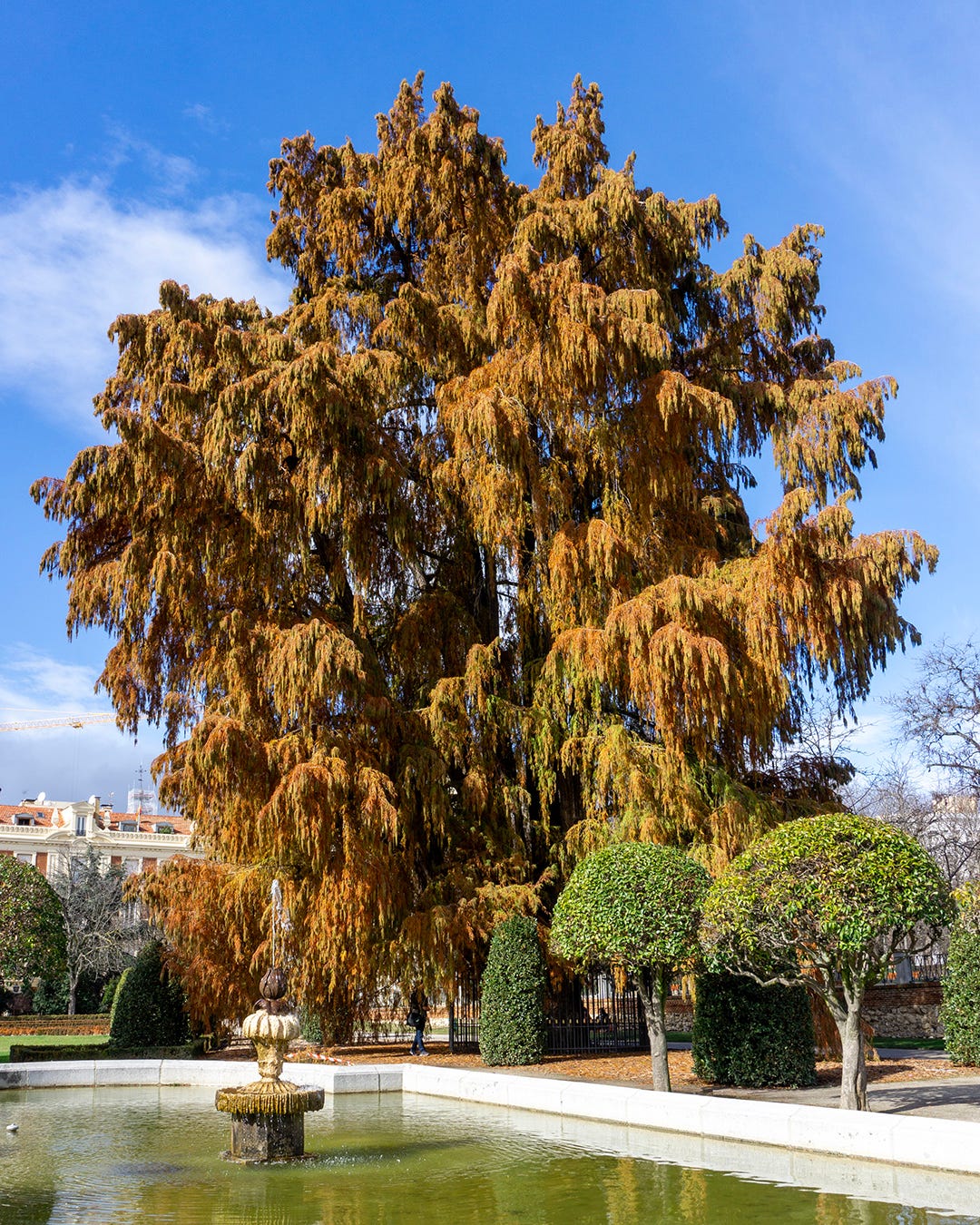
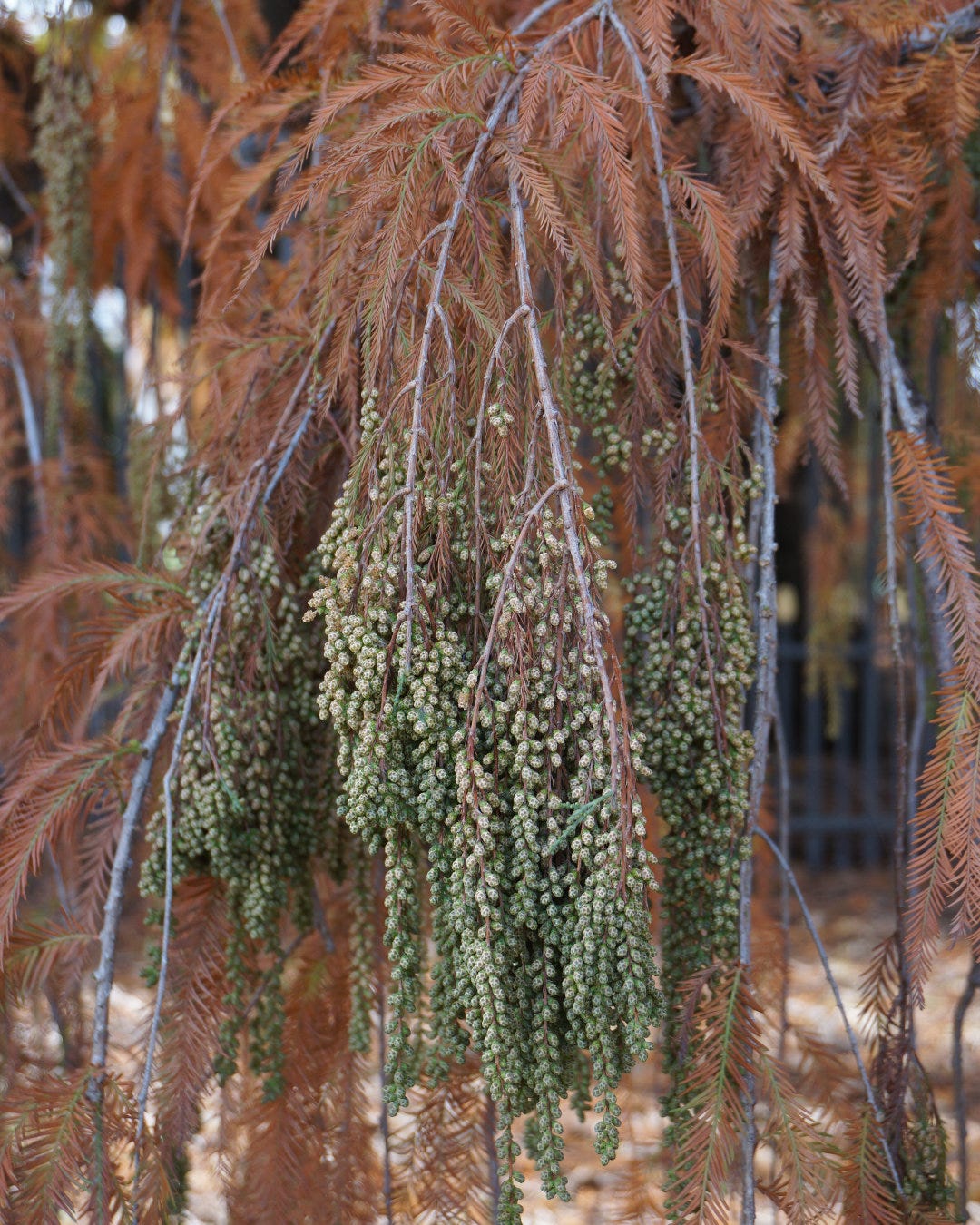
In winter, the great shaggy heap of what some claim is Madrid’s oldest tree, a Montezuma cypress, declines to drop its needles. This sets it apart from its near relative, the swamp cypress. Instead, it turns a startling russet colour, standing out dramatically from the leafless planes and green cedars that surround it. In all seasons it is worth visiting to admire its sheer size. Below its canopy, ten or so limbs arch upwards from a low bole appearing as if it had been pollarded many decades ago.
Species details
Montezuma cypress
Taxodium mucronatom
Where to find it
Parque de El Retiro, 28009 Madrid, Spain
///downturn.weekend.polished | 40.415656, -3.687996
Montezuma cypress notes
This is a tree with many common names: Montezuma cypress, Mexican cypress or ahuehuete (an Aztec Nahuatl name) and plenty of confusion when it comes to its botanical classification too. Some authorities regard it as a distinct species, Taxodium mucronatum, while others claim it to be a variety of swamp cypress, Taxodium distichum var. Mexicanum. The key characteristics that distinguish it from a regular swamp cypress are semi-evergreen needles and pendulous branches, but it also flowers at a different time (in the winter) and does not produce the woody ‘knees’. Admittedly, those knees – large woody nodules that spring up from the roots around the trunk, are rarely seen in cultivation. In the wild, the Montezuma cypress is chiefly found in Mexico with a few outlying populations in Guatemala and the southern United States, whereas swamp cypresses are confined to the southeastern US. Famously, the Árbol del Tule, the world’s stoutest tree, is a Montezuma cypress. Rest assured, if ever I visit Mexico – it grows in the small town of Santa María del Tule in the southern state of Oaxaca – I will post an account here.