

194. Major Oak RIP
The demise of one of England’s most visited trees warrants a longer post.

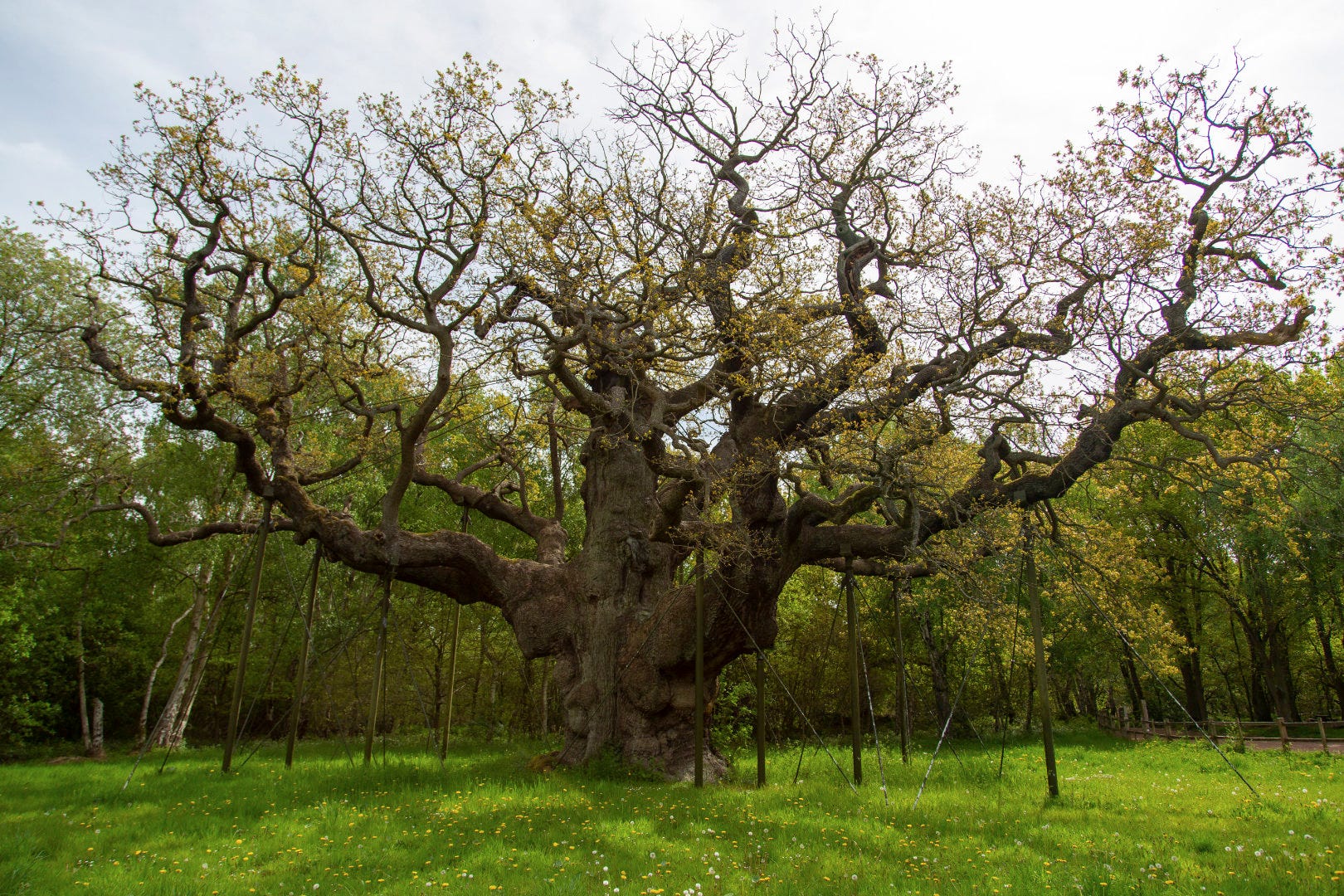
Earlier this week, the death of Major Oak was announced. The tree died back last summer and failed to produce new leaves this spring, but just to make sure, presumably, the tree’s custodians waited until June to make the announcement. The media were quick to pounce on the story and it has been widely reported over the last week. Every other post on my instagram feed has been about this tree too, so there is obviously a lot of interest, and many people have felt the loss personally.
Major Oak was one of the most famous trees in England, it grew in Sherwood Forest for hundreds of years, maybe even a millennium. What is left of the forest, which once stretched to the edge of Nottingham, now surrounds the village of Edwinstowe. It continues to be one of the most important ancient tree sites in England.
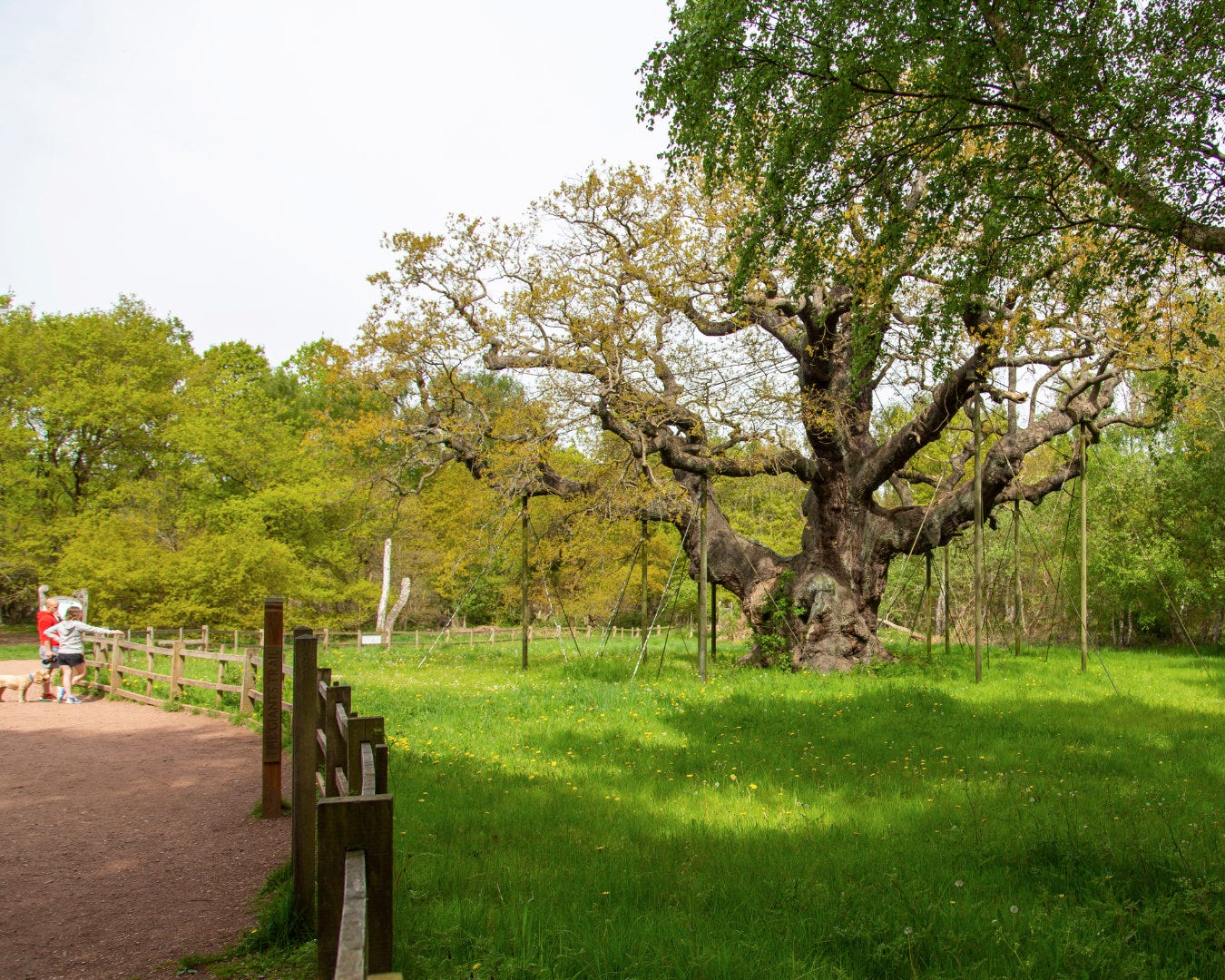
I was asked by BBC Radio Sheffield (a city that lays claim to the legend of Robin Hood almost as much as Nottingham) to comment about the tree, and the first question I was asked was ‘why was it called the Major oak?’ Fortunately I had done my homework and was able to tell the presenter that it was named after Major Hayman Rooke who had surveyed Sherwood Forest in 1790 and recorded the height and girth of its mightiest trees. Before the Major wrote about it, the Major Oak had been known as the Queen or Cockpen Oak (its hollow trunk had at one time been used as a pen for birds that were to take part in cockfights). There is some debate as to whether Rooke’s measurements (a girth of 31 feet, 9 inches) was for our tree, a sketch of which was included in his report, or another, equally aged and enormous tree that had been known as the Shambles Oak. The hollow of which had been used to store venison, shambles being analogous to butcher’s shops. It was severely damaged in 1913 and, after it finally blew down in 1961, metal hooks were found inside the tree.
Despite the death of this most enigmatic, and much visited tree, the nature reserve where it will continue to reside is still a very important and historic place. It is full of very old trees in various states of life and death. In the late 1990s a survey discovered 1,643 ancient trees, only 991 of which were alive. If left standing, as Major Oak will surely be, a dead oak tree supports a vast array of other life who will be finding sustenance and finding shelter in its remains. We should celebrate the afterlife of such an important tree as we venerated it when it was alive.
Species details
Pedunculate oak
Quercus robur
Where to find it
Edwinstowe, Mansfield NG21 9PF
///catchers.hampers.feels | 53.204547, -1.072602


Like fortuna, I also saw this tree as a child, from the inside. Somewhere in my father’s photographs was his capture of me and my brother looking out of the hollow. How many hundreds of such photographs and memories exist?! I hope the tree can be allowed to simply decay and collapse naturally, to be a study of importance in death.
🌳☠️😢 My parents, who were from Nottingham, took my brother & me to see this tree, presumably before it was fenced off in 1974, as I remember entering the hollow trunk in which Robin Hood had supposedly hidden. My memory, which may be inaccurate as it is casting back over fifty years, was that the interior had been sprayed with a plastic coating to protect it, which to me looked comical - a plastic tree! The poles supporting the branches were also a strange sight. But it was my introduction to ancient trees, which were not prominent in the culture in the seventies. May the dead Major Oak remain for many more years and give life and a home to many organisms!