


A Swings and Roundabouts post. I became aware of how interesting parks are having visited hundreds across Britain and Ireland looking for remarkable trees. I can confirm that our parks are full of great trees, but I can also confirm that our parks are fascinating. Each is unique and each has a great story to tell.
To start my new Substack column, I thought I would focus on one of my favourite and relatively local parks. Waterlow Park in Highgate (I don’t, alas, live in Highgate) is fairly small, just 26 acres, or 10.5 hectares, but it packs a lot in.
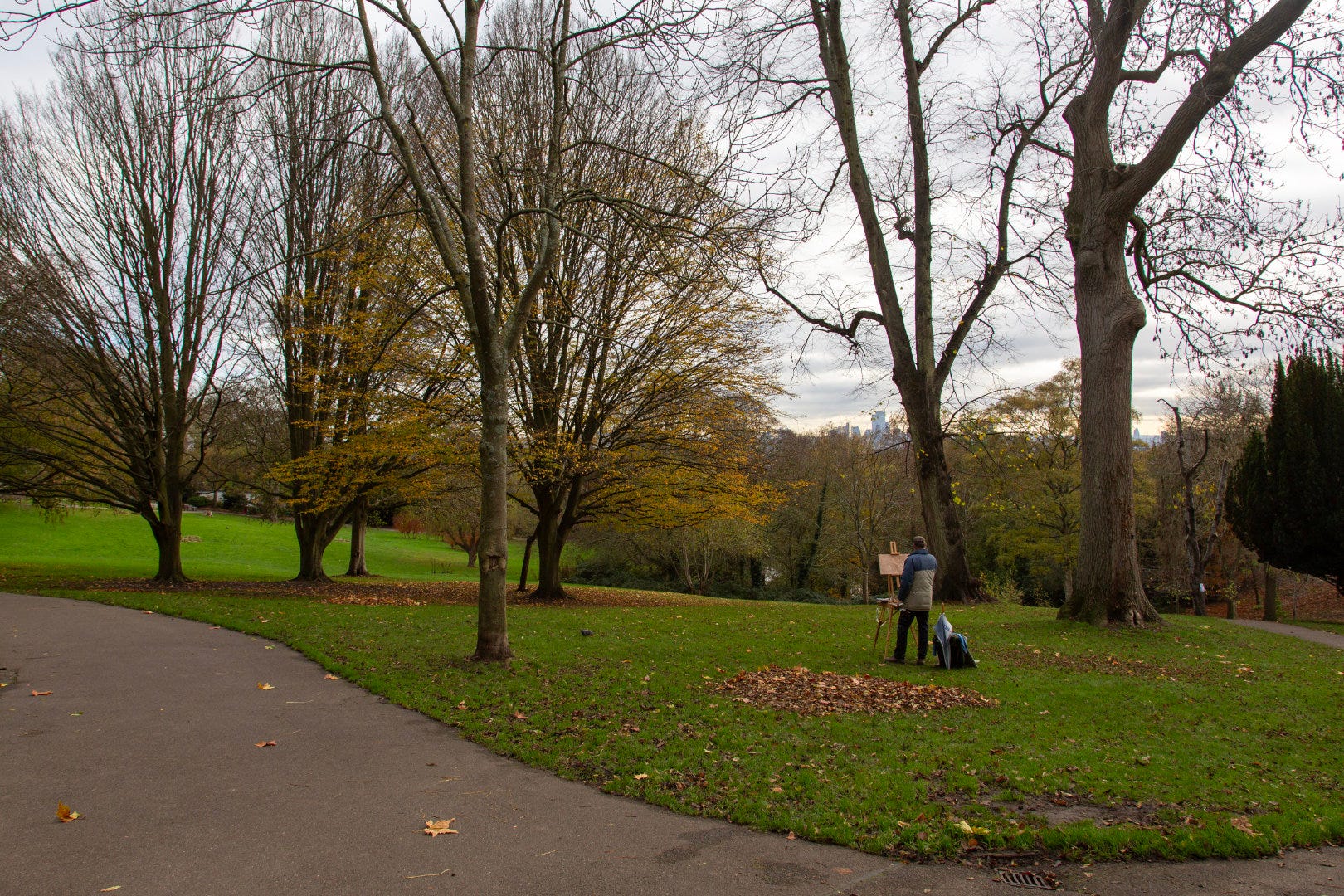
It occupies a sloping site in Highgate above the Whittington Hospital and below the centre of Highgate Village. Excellent views of London’s skyline can be had from the higher parts, and where it adjoins Highgate Cemetery at the southern end, the keen-eyed can spot the bearded bust of Karl Marx’s grave through the railings. I don’t think I know another park that offers so much variety in such a small area; it feels like a series of green rooms. In the south east corner, this is quite literally the case where four small hedged compartments – once the kitchen garden – each contain a hidden micro garden of their own.
This feeling of green rooms or compartments is unsurprising when you learn of the park’s history1. It was originally four private gardens including that of the 17th century Hullensian2 poet Andrew Marvell3 who is remembered on a plaque attached to the park wall on Highgate Hill where his cottage once stood.
Sir Sydney Waterlow, one time Lord Mayor of London, and resident of one of the houses whose gardens would come to form the park, bought out his neighbours and combined their gardens into one large private estate. By the 1880s, Waterlow had decided to sell up, but after failing to find a buyer he made the supremely generous donation of the estate to the London County Council4 in 1889 who opened it to the public as Waterlow Park in 1891. He described it as a gift for ‘the enjoyment of Londoners’5. A statue of Waterlow was erected by public subscription in 1900.
One of the principal entrances to the park is via Lauderdale House, an attraction for many visitors as a venue for craft fairs and amateur art exhibitions. Lauderdale House is actually of considerable age and interest; it was once the home of Nell Gwynn, mistress to Charles II. It is of half-timbered construction, which is hidden behind its rendered neo-classical exterior. This makeover was completed in 1760, an unusual Georgian ‘hatchet job’ where an unfashionable building was updated – much like seeing a 1930s semi modernized with new satin grey doors and a paved-over front garden. Visitors may also notice that the park encircles part of Channing School which is well screened by an austere high brick wall. This Victorian building was originally Fairseat House, Waterlow’s own home which, owing to complex lease arrangements was not part of the gift and despite attempts by the council to purchase it, it remains disconnected from the park.
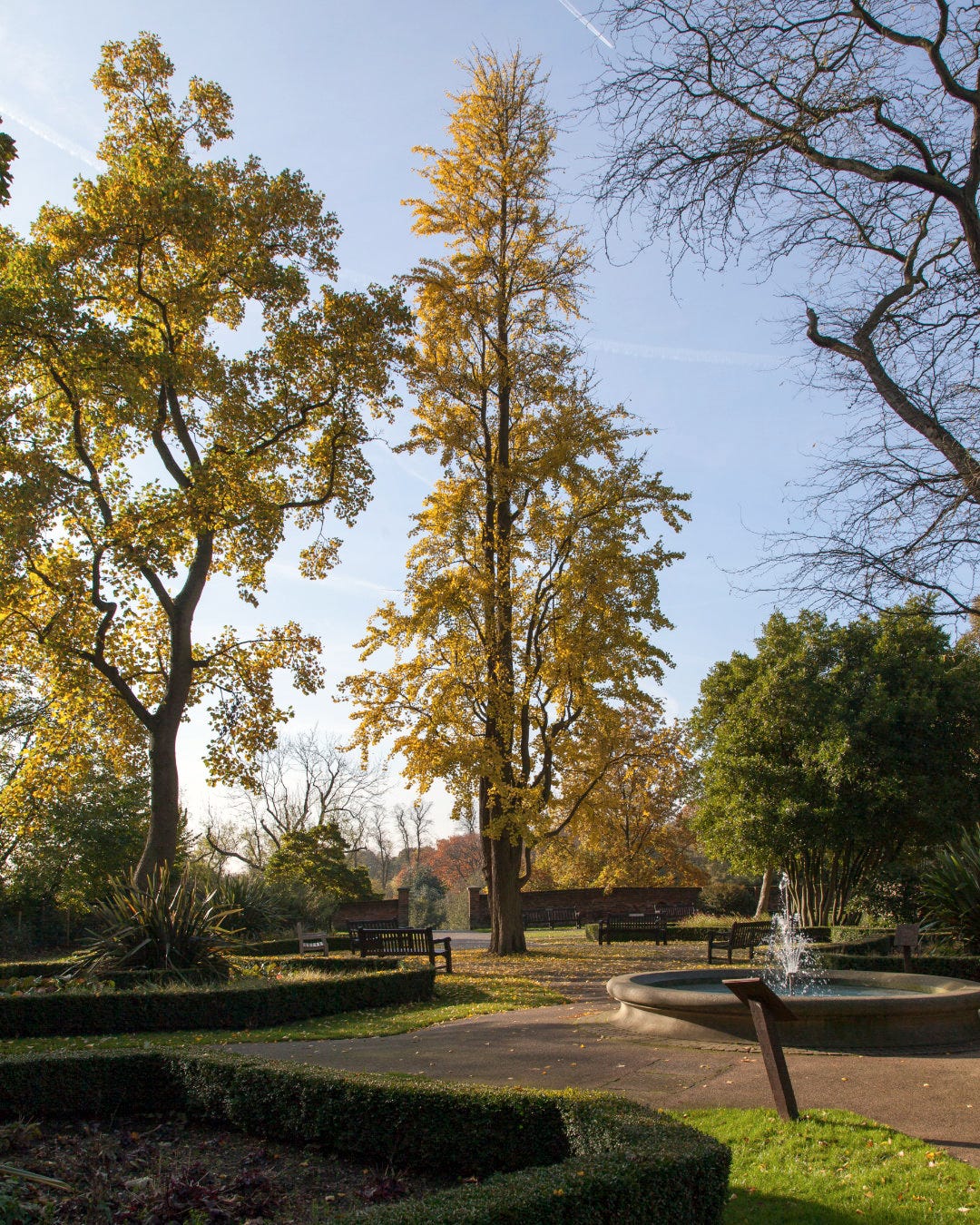
Usually, I enter the park at the upper Dartmouth Park gate where formal planting surrounded by dense shrubs and the canopy of giant planes acts to immediately envelop visitors. There is a sense of the sloping site here too with steps soon leading up to the formal garden on the right and a path sloping down to the Waterlow Park Centre6 and aviaries (where I have never seen any birds) on the left. Take the steps up to the formal garden passing just below Lauderdale House to discover the most exhilarating compartment. Here are three of the finest trees in the park: the astonishing strawberry tree (Arbutus unedo), London’s best, an elderly honey locust (Gleditsia triacanthos), the oldest I have seen in the UK, and a towering ginkgo (Ginkgo biloba). There’s a charmingly grotesque fig too.
The formal garden is terraced and has several features of note (not least the park café at the rear of Lauderdale House) including the fountain by the strawberry tree, rustic 17th century figures on the steps up to the café terrace and the eagles at the bottom of the steps leading down to the main lawn.
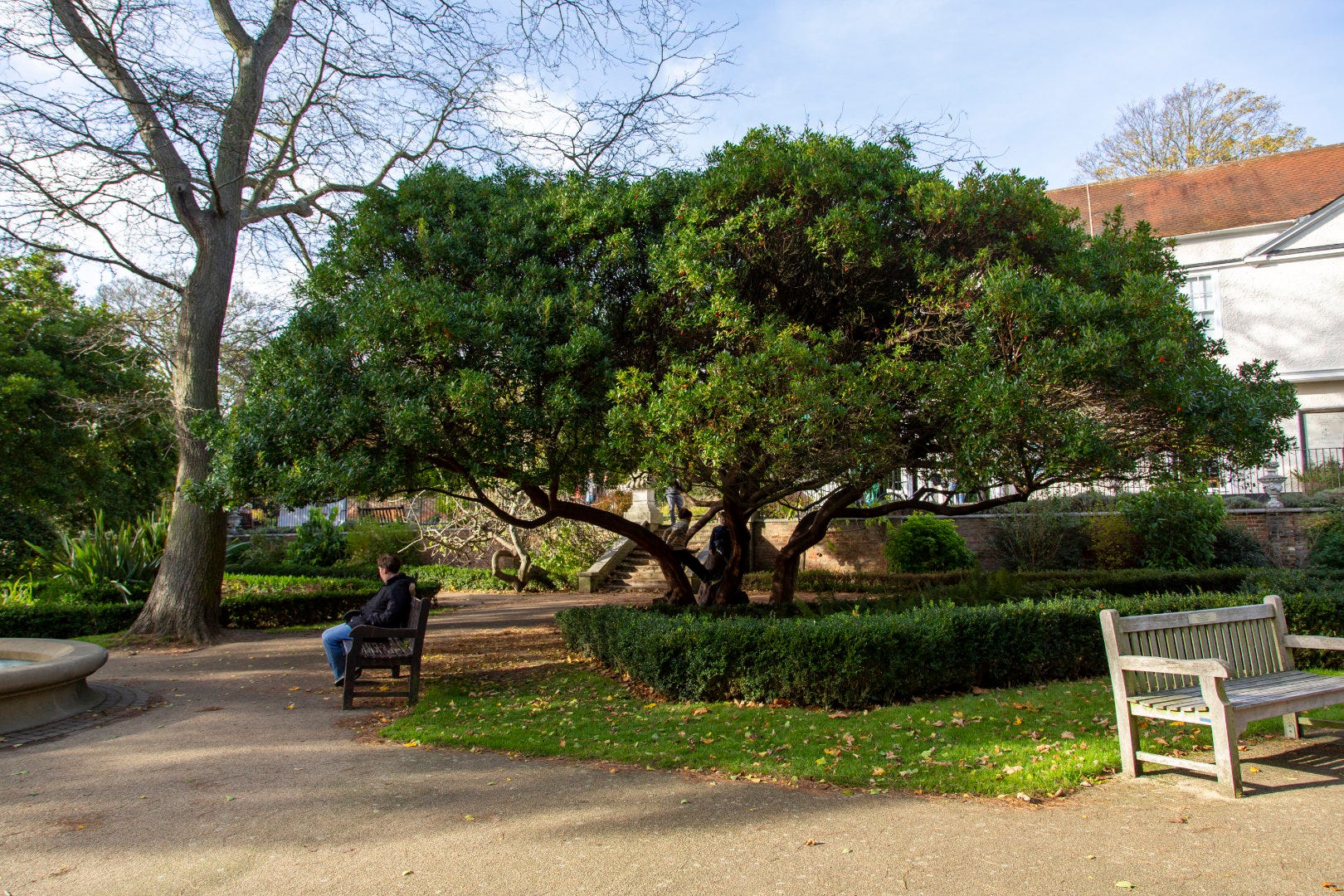
Like many parks, there’s a tree trail7 – but, like many, it focuses on the obvious and omits some of the most interesting trees which visitors should seek out. The strawberry tree is marked number 11, but the honey locust and ginkgo (despite both having botanical labels attached to their trunks) don’t get a look in. The trail redeems itself for putting the great pedunculate oak (Quercus robur) at number 1. This is the park’s oldest tree, one which might be as old as Lauderdale House, it is a veteran hollow oak lurking in the undergrowth, unnoticed by many. Other highlights include an old lime (Tilia x europaea) avenue on the western side. It must be a remnant of one of the old houses which are now long gone, as it now finds itself high and dry with no obvious reason for its start or end. Look out too for a huge black walnut (Juglans nigra) partially hidden near Lauderdale house, a red maple (Acer rubra), like the honey locust, the oldest and biggest I have seen in the UK, near the lower Dartmouth Park Hill entrance, a lovely hornbeam (Carpinus betulus) is an obvious feature and there’s a good swamp cypress (Taxodium distichum) by the upper lake. These are just a few of the delights of Waterlow Park, it is truly a gem of a park.
Waterlow Park details
Visit: Waterlow Park, Highgate Hill, London N6 5HG
Community: Friends of Waterlow Park
Managed by: Waterlow Park Trust and London Borough of Camden
The four estates were Lauderdale House, Hertford House, Elm Court (home to James Pennethorne, designer of London’s Victoria and Battersea Parks) as well as Andrew Marvell's cottage.
Yep, that’s the demonym for someone from Hull.
As well as this plaque on Highgate Hill, attached in 1898 by the London County Council, English Heritage records a second plaque within the park https://historicengland.org.uk/images-books/photos/item/MF001657/17 which shows the last stanza of Marvell’s poem, ‘The Garden’. I have not yet located this plaque.
The park is now managed by the London Borough of Camden.
Home to Lux, ‘an arts organisation that supports and promotes visual artists working with the moving image’, the inheritor of the London Film-makers Coop, an important institution on the London arts scene since the 1960s.
One of my favourites, too. Including the sundial (don't know how old) in the formal garden
It sounds wonderful, what a jewel of a place with those trees.